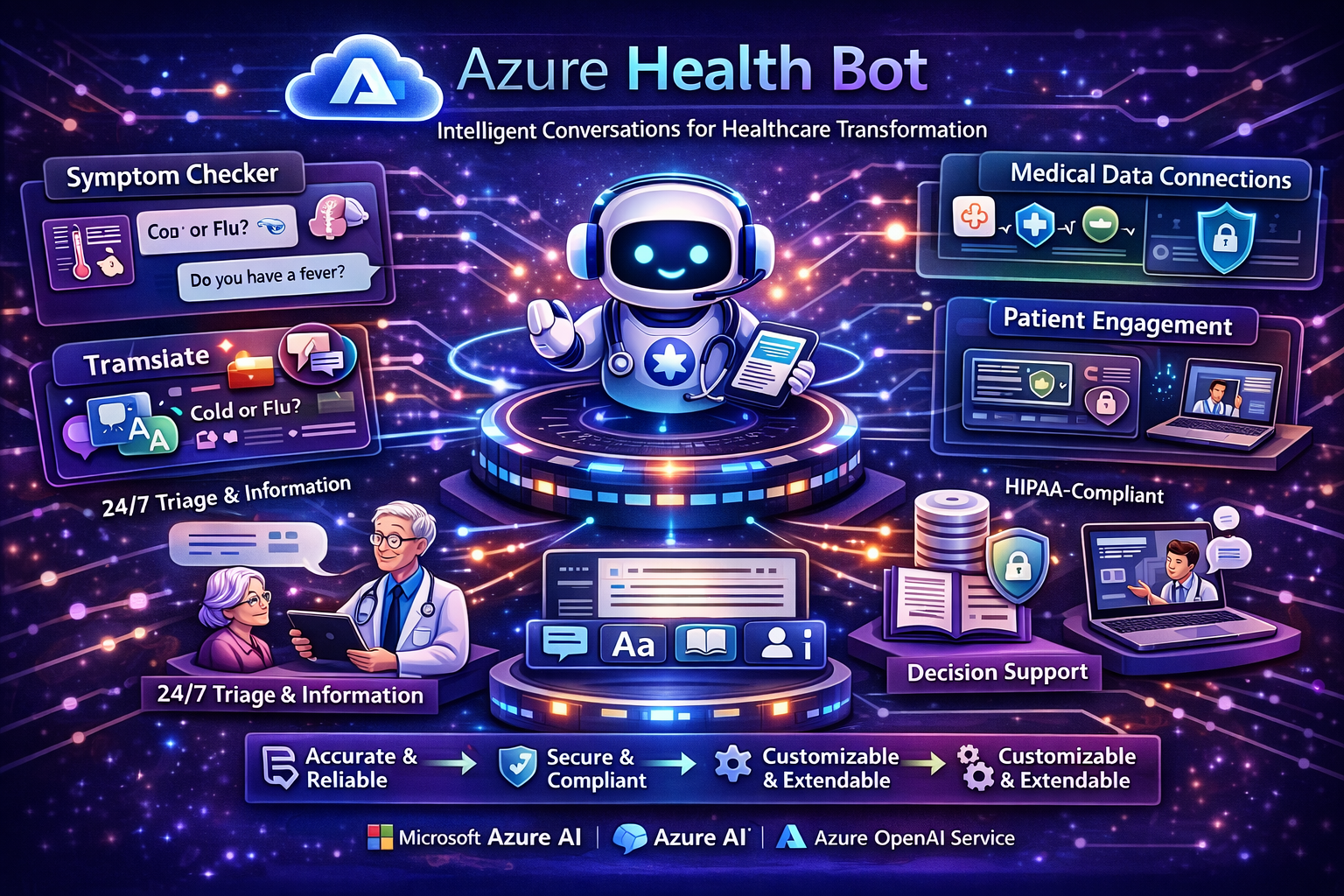
Understanding Azure Health Bot
Azure Health Bot is Microsoft’s healthcare-focused conversational AI service designed to help organizations build and deploy virtual health assistants for clinical, operational, and patient engagement scenarios. Unlike general chatbot platforms, it is purpose-built for healthcare environments where conversations often involve medical terminology, symptom-related questions, triage guidance, operational workflows, and compliance-sensitive interactions.
This makes Azure Health Bot especially valuable for organizations that need conversational experiences tailored to healthcare realities. Patients, members, caregivers, clinicians, and administrative teams often need timely, clear, and trustworthy answers. Azure Health Bot provides a structured way to deliver those experiences while aligning with the operational and regulatory expectations common in healthcare and life sciences settings.
Why Healthcare Needs Specialized Conversational AI
Healthcare conversations are fundamentally different from many other digital interactions. They often involve clinical language, emotionally sensitive concerns, identity-related workflows, symptom descriptions, scheduling needs, benefit questions, and care coordination tasks. A generic conversational system may not be sufficient for these situations because healthcare requires a higher level of contextual understanding, trust, safety, and process alignment.
Azure Health Bot matters because it brings conversational AI into healthcare with a service model designed around those needs. It helps organizations reduce friction for patients and staff, improve access to information, and create digital experiences that are more responsive to healthcare-specific use cases. Rather than forcing organizations to start from a general-purpose bot and adapt everything from scratch, it offers a more healthcare-aware foundation.
Core Capabilities of Azure Health Bot
Azure Health Bot includes several capabilities that make it suitable for intelligent healthcare conversations across both patient-facing and operational scenarios.
-Healthcare-Focused Conversational Design: Supports virtual health assistant experiences built for patient engagement, member support, care access, and healthcare operations.
-Built-In Medical Intelligence: Provides configurable medical knowledge and healthcare-oriented conversational support for scenarios such as symptom-related guidance and condition-based information.
-Generative AI Copilot Scenarios: Supports newer AI-powered healthcare assistant experiences that can streamline interactions and improve service delivery.
-Workflow Customization: Allows organizations to tailor conversations and business flows to their own care models, operational processes, and digital service goals.
-Handoff to Human Support: Enables escalation and transition to live staff when human review or intervention is needed.
-Localization Support: Helps organizations design multilingual and regionally appropriate conversational experiences.
-Telemetry and Management Integration: Supports operational oversight and broader Azure-based management for production healthcare assistant deployments.
From Healthcare Chatbot to Intelligent Healthcare Assistant
The role of conversational AI in healthcare has evolved. Earlier healthcare bots often focused on narrow FAQ responses or simple navigation support. Today, organizations increasingly want assistants that can help with symptom-related guidance, answer benefit or coverage questions, support scheduling flows, streamline operational tasks, and provide more contextual digital experiences for patients and staff.
Azure Health Bot reflects this evolution by supporting more advanced healthcare assistant scenarios rather than only static scripted exchanges. This is important because healthcare transformation depends not only on digitizing forms and portals, but also on making healthcare interactions more accessible, more efficient, and more responsive to real user needs.
Built-In Medical Intelligence and Clinical Relevance
One of the defining strengths of Azure Health Bot is its healthcare-specific intelligence. In healthcare environments, conversational systems need to work with clinical terminology, condition-related questions, and medically relevant content in a way that feels more informed than a general-purpose support chatbot. Azure Health Bot is designed with this domain in mind, which helps organizations create more relevant experiences for healthcare users.
This does not remove the need for governance or clinical oversight, but it does provide a stronger starting point for healthcare conversation design. Organizations can use this built-in healthcare orientation as a foundation and then customize the experience further for their own patient populations, operational workflows, and service strategies.
Symptom Checking, Triage, and Care Navigation
A major healthcare use case for Azure Health Bot is helping users navigate symptom-related concerns and identify the most appropriate next step. In many healthcare environments, patients need guidance before they know whether to seek urgent care, schedule an appointment, consult a clinician, or access trusted medical information. Conversational assistance in this area can reduce uncertainty and improve the overall care access experience.
This capability is especially valuable because it can support digital front-door strategies in healthcare. By guiding patients more effectively, organizations can reduce friction, improve service access, and help ensure that patients receive more appropriate navigation through the healthcare system.
Operational Efficiency and Administrative Support
Healthcare transformation is not only about clinical interactions. It also involves reducing the operational burden on staff and making administrative processes more efficient. Azure Health Bot can support this by helping answer common questions, assist with scheduling-related workflows, provide information about services or benefits, support intake and triage processes, and reduce repetitive communication handled manually by call centers or support teams.
This matters because administrative workload is a major challenge in healthcare. Intelligent conversation can improve service delivery by handling routine interactions more efficiently while allowing staff to focus on higher-value and more sensitive cases that require human attention.
Patient Engagement and the Digital Front Door
Healthcare organizations increasingly need strong digital entry points for patients and members. Whether the goal is answering questions, supporting care access, guiding users to the right service, or improving responsiveness outside traditional service hours, the digital front door has become an important part of healthcare strategy. Azure Health Bot helps strengthen that digital entry point by enabling more interactive and accessible conversational experiences.
Instead of forcing patients to navigate complex websites or wait for human support for every question, organizations can provide a virtual health assistant that helps users move through common journeys more naturally. This can improve patient satisfaction, reduce friction, and make digital health services feel more responsive and supportive.
Handoff to Human and Trust-Centered Design
In healthcare, no conversational AI solution should be designed as if it can replace all human interaction. There are many scenarios where live escalation, staff intervention, or clinical review are essential. Azure Health Bot supports this reality through handoff capabilities that allow conversations to transition to human support when needed.
This is a critical design principle because trust in healthcare AI depends on knowing when automation is appropriate and when people must remain directly involved. A successful healthcare assistant is not one that tries to automate everything. It is one that improves access and efficiency while still respecting the need for human care, judgment, and accountability.
Localization and Broader Access
Healthcare organizations often serve diverse populations across languages, regions, and cultural contexts. Azure Health Bot supports localization, which is important for making digital healthcare experiences more inclusive and more practical across different communities. A healthcare assistant becomes far more valuable when it can align with the communication needs of the people it serves.
This capability also matters for large health systems, multinational healthcare organizations, and life sciences companies that need to support multiple geographies. Localization helps extend the reach of digital healthcare services without forcing organizations to rebuild the entire experience separately for every market.
How Azure Health Bot Fits into the Microsoft Healthcare and AI Ecosystem
Azure Health Bot becomes most valuable when it is used as part of a broader Microsoft healthcare and Azure AI architecture. In many enterprise scenarios, it acts as the conversational engagement layer while other Microsoft services provide data, automation, analytics, search, security, and AI enhancement.
-Microsoft Cloud for Healthcare: Provides a broader industry cloud context for healthcare transformation across patient engagement, care coordination, and data strategy.
-Azure OpenAI Service: Can complement healthcare assistant scenarios with generative AI patterns when organizations need richer AI-driven experiences.
-Azure AI Search: Helps support grounded retrieval when healthcare assistants need to respond from trusted organizational knowledge.
-Azure AI Language and Speech: Extend health bot scenarios into text understanding, multilingual processing, transcription, and voice-enabled experiences.
-Power Platform and Workflow Automation: Support process integration, notifications, escalations, and operational automation around healthcare conversations.
-Microsoft Entra, Azure Monitor, and Key Vault: Strengthen identity, security, observability, and secrets management across production healthcare assistant environments.
Architecture Considerations for Production Healthcare Assistants
A production-ready healthcare conversational solution requires more than a chat interface. Teams must think carefully about conversation design, escalation paths, knowledge governance, workflow integration, compliance boundaries, localization, telemetry, and how the assistant fits into the broader patient or operational journey. These design decisions strongly affect safety, usefulness, and trust.
In many enterprise healthcare architectures, Azure Health Bot is connected to digital front-end channels, internal business logic, scheduling systems, support workflows, identity controls, and analytics platforms. The goal is not only to create a virtual assistant, but to create one that is operationally meaningful, clinically appropriate, and manageable at scale.
Governance, Compliance, and Responsible Healthcare AI
Healthcare AI requires a particularly strong governance model because conversations may involve sensitive information, regulated processes, and high-impact user decisions. Azure Health Bot is designed for compliant healthcare assistant scenarios, but organizations still need clear governance around what the assistant is allowed to do, what content it presents, how interactions are monitored, and when escalation is required.
Responsible AI is especially important in healthcare because user trust depends on clarity, safety, and appropriate boundaries. Organizations should approach Azure Health Bot with strong review processes, clinically informed design, clear disclaimers where necessary, and robust operational oversight. The goal is not only to automate healthcare interactions, but to do so responsibly and in a way that supports better care and service outcomes.
Key Business Use Cases
Patient Triage and Symptom Guidance
Healthcare organizations can use Azure Health Bot to support symptom-related conversations and guide patients toward appropriate next steps. This can improve digital access to care and reduce uncertainty in early-stage patient interactions.
Member and Patient Support
Health bots can answer common questions about services, navigation, benefits, care access, and healthcare processes, helping users get timely information without waiting for manual support.
Administrative Workflow Support
Organizations can use Azure Health Bot to reduce repetitive support interactions, streamline intake-related communication, and support operational workflows that otherwise place pressure on staff and service teams.
Digital Front Door Experiences
Health systems can make their digital entry point more interactive by using conversational guidance for access, service navigation, and patient engagement journeys across web and mobile channels.
Healthcare Copilots and Future Agent Scenarios
As healthcare AI evolves, Azure Health Bot also supports a path toward more advanced AI-powered healthcare copilots that can streamline interactions and improve service delivery across operational and patient-facing experiences.
Best Practices for Adopting Azure Health Bot
-Start with a Focused Healthcare Use Case: Begin with a scenario such as symptom guidance, patient support, or administrative automation where conversational AI can create clear value.
-Design with Clinical and Operational Oversight: Involve healthcare and compliance stakeholders early so the assistant aligns with real care and service expectations.
-Use Human Handoff Strategically: Ensure the bot can escalate appropriately when questions become sensitive, high-risk, or operationally complex.
-Ground the Experience in Trusted Content: Use approved healthcare information, organizational policies, and validated workflows to strengthen reliability.
-Plan for Localization and Inclusion: Design the experience to support the language and accessibility needs of the population being served.
-Treat Governance as Core Design: Define boundaries, permissions, telemetry, and review processes from the start rather than after deployment.
Common Challenges Organizations Should Address
Although Azure Health Bot provides a strong healthcare-oriented foundation, successful implementation still requires thoughtful planning. Common challenges include overly broad first use cases, weak escalation design, unclear content governance, insufficient clinical review, and unrealistic assumptions about how much can be automated safely in healthcare settings.
Another challenge is viewing healthcare conversation only as a chatbot problem. In reality, the most effective solutions connect conversation to access, workflow, trust, and service design. The strongest implementations are the ones that treat the health bot as part of a broader digital care and operations strategy rather than as an isolated interface.
The Strategic Value of Azure Health Bot
Azure Health Bot delivers strategic value by helping healthcare organizations modernize how they interact with patients, members, and staff. It creates opportunities to improve access, reduce operational burden, strengthen digital front-door strategies, and support more responsive service delivery through healthcare-aware AI conversation.
For healthcare leaders, this means conversational AI can become more than a convenience feature. It can evolve into an important part of digital transformation by improving how information is delivered, how workflows are supported, and how people move through healthcare services more efficiently.
The Future of Healthcare Conversation on Azure
The future of healthcare conversational AI is moving toward more capable assistants, richer generative AI experiences, stronger healthcare-specific grounding, and better integration with clinical and operational systems. Organizations will increasingly expect healthcare assistants to do more than answer questions. They will expect them to guide, coordinate, and support real healthcare journeys in a trustworthy way.
Azure Health Bot is well positioned for this direction because it combines healthcare-specific intelligence with customization, escalation, and enterprise integration. As healthcare organizations continue investing in digital transformation, intelligent conversational services will likely play a growing role in improving access, efficiency, and patient engagement across the care ecosystem.
Conclusion
Azure Health Bot is enabling intelligent conversations for healthcare transformation by giving organizations a way to build virtual health assistants that are more healthcare-aware, more compliant, and more operationally useful than general-purpose chat systems. With capabilities that support medical intelligence, symptom-related guidance, handoff to human support, localization, and workflow customization, it provides a strong foundation for modern healthcare conversation design. For organizations looking to improve patient engagement, streamline administrative work, and modernize digital healthcare experiences, Azure Health Bot represents a powerful and increasingly strategic solution.